
WEBSITES · AUGUST 30, 2026
The Best Therapist Websites: 15 Teardowns With Platform, Cost and Load Time
Most "best of" lists for therapist sites are a gallery with no criteria. We opened the source on fifteen, ran each through Lighthouse on throttled mobile, priced the build, and ranked them.
We opened the page source on fifteen private practice sites, ran each through Lighthouse on a throttled mobile connection, and estimated the build cost from the platform, the template and how much custom work is visible. Then we ranked them. Most lists of the best therapist websites are a screenshot gallery with no criteria behind the order. This one has an order, and a defended top spot.
The best therapist websites in this sample share three things: they load in under three seconds on a phone, they answer the fee question without making anyone email, and they are built on a platform the owner can edit alone. Cost ranged from under $300 to about $15,000. Platform mattered far less than the decisions made inside it.
How we chose the fifteen
We started from roughly ninety sites collected over six months through state association directories, therapist Instagram accounts and referral pages. We kept fifteen a prospective client could actually use: the fee is findable, the next step is obvious, the site works on a phone held one-handed.
Platform came from the page source: generator meta tags, asset paths, script hosts. Lighthouse scores are performance only, mobile, simulated slow 4G, median of three runs, measured in August 2026. Scores drift, so treat them as a snapshot rather than a grade.
Cost is an estimate, not a disclosure; where we were unsure we took the lower band. We also describe each site by specialty and city rather than naming it: putting a colleague's practice into a public ranked list without asking is not something we want to do, and the useful part is the decision, not the domain. For a wider survey, our therapist website examples piece covers more sites in less depth.
| Practice | Platform detected | Est. build cost | Lighthouse (mobile) | The one decision |
|---|---|---|---|---|
| Couples therapist, Brooklyn NY | Framer | $3,000–6,000 | 96 | States current availability in weeks |
| Telehealth LCSW, multi-state | Carrd | under $300 | 99 | Licensed-states list is the hero, not the bio |
| Psychodynamic PhD, Boston MA | Hand-coded static | $4,000–7,000 | 97 | Three essays instead of a credentials wall |
| Neurodivergent-affirming, Minneapolis MN | Framer | $3,500–6,000 | 93 | Motion-off and dark-mode toggle in header |
| Group practice (12), Chicago IL | Webflow | $8,000–15,000 | 94 | Directory filters by insurance and modality |
| ADHD-focused, Phoenix AZ | Webflow | $5,000–9,000 | 91 | Sliding scale explained with actual numbers |
| EMDR solo, Denver CO | Squarespace 7.1 | under $500 (DIY) | 88 | Plain "what a first session looks like" |
| Bilingual practice, Miami FL | Squarespace 7.1 | $2,000–4,000 | 84 | Spanish pages written, not machine-translated |
| Solo trauma practice, Portland OR | Squarespace 7.1 | $1,500–3,000 | 82 | Fee sits above the fold on the home page |
| Group practice (5), Seattle WA | Squarespace 7.1 | $2,500–5,000 | 79 | Per-clinician booking links, no central inbox |
| Somatic practice, Oakland CA | Squarespace 7.0 | $1,000–2,000 | 73 | A real photograph of the therapy room |
| Perinatal therapist, Austin TX | Wix Studio | $800–1,500 | 71 | One service, one page, no menu |
| Eating disorder specialist, Nashville TN | WordPress + Kadence | $1,500–3,000 | 66 | A referral page written for other clinicians |
| Faith-based counseling, Dallas TX | Wix | $600–1,200 | 58 | Faith stance stated plainly in forty words |
| Child and adolescent, Raleigh NC | WordPress + Divi | $2,000–4,000 | 44 | Intake form is six fields, nothing optional |
The best therapist websites, ranked
1. Couples therapist, Brooklyn NY — Framer, 96
This site wins on one sentence near the top: Currently booking new couples for late September, typically a two to three week wait. It is dated. It changes. Nothing else in the sample does this, and it is the most valuable line a private practice can publish.
Consider what it removes. The most common reason a prospective client abandons a therapist's site is not price or credentials — it is the suspicion that the form goes nowhere. A stated wait time answers that before the question forms, and it filters: someone in crisis reads "three week wait" and goes elsewhere, the right outcome for both of you. The rest is disciplined — system fonts, four images, no video, three pages.
2. Telehealth LCSW, multi-state — Carrd, 99
A single Carrd page, under $300 including the domain, and the fastest site in the sample by a distance. The hero is a list of six states with license numbers. For a telehealth-only practice that is the qualifying question, and putting it first saves everyone a wasted intake call.
It ranks second because it is close to its ceiling: if this clinician adds a group program next year, the page has nowhere to go. Worth saying plainly, though — a $300 site that answers the right question outperforms a $6,000 site that buries it.
3. Psychodynamic PhD, Boston MA — hand-coded static, 97
Three long essays on the home page, no stock photography, no headline about your best self. The writing is the credential — and this is the least replicable site here, because no template supplies that.
Fourth and fifth are close behind. The Minneapolis practice earns its place with an accessibility control most $10,000 builds skip: a header toggle that kills animation and switches to a dark theme. The Chicago group practice is the best multi-clinician site here, because its directory filters by insurance accepted.
What each cost band actually buys
Under $500, DIY on Squarespace or Carrd, you buy speed and control and pay for it in typography. The Denver EMDR site scores 88 and reads well because the owner wrote good copy and used three photographs. It is the cheapest site here a stranger would call professional.
Between $1,500 and $5,000 you are usually paying a designer to customise a template, and results scatter hardest. Two Squarespace 7.1 sites scored 82 and 79; a WordPress build in the same band scored 66. The money bought layout, not performance.
Above $5,000 you are buying a system: a clinician directory, a booking integration, a real content model. The Chicago build justifies $8,000 to $15,000 because twelve clinicians share it and each gets a profile page that ranks on their own name. A solo practice paying that is buying a system it will never fill — arithmetic we worked through in our private practice website design budgets.
The three decisions that separated the top from the bottom
Fee visibility. Nine of the fifteen publish a number, including all four sites scoring above 90. That is not a performance effect. It signals an owner who made a decision instead of deferring one, and the habit shows up everywhere else on the page.
Image weight. The two lowest scores, 44 and 58, both load full-width sliders with four or more uncompressed hero images. The Raleigh site ships roughly 4 MB of imagery on the home page. Compressing those to WebP under 200 KB each would likely move it into the seventies without touching the design.
Page count. The fastest sites have three to five pages. The slowest have eleven, fourteen, and in one case a blog with two posts from 2021. Pages you do not maintain are not neutral. They age visibly.
The weak hero sections, and the one-line fix
Four sites open with a variation of "Welcome. I'm glad you're here." It is warm and empty. The Dallas site recovers by following it with a plain statement of its faith stance, genuinely useful to the people it is written for.
The fix is the same line every time: who you work with, what you work on, whether you are taking clients. I work with couples in their thirties and forties on repair after infidelity. Booking for late September. Two sentences, no adjectives, and it outperforms every hero image in this sample.
What none of the fifteen do
Not one uses a client testimonial. That is not an accident of selection — it reflects the codes. ACA C.3.b prohibits soliciting testimonials from current clients or from former clients vulnerable to undue influence; APA 5.05 and NASW 4.07 are comparable. The strongest sites substitute specificity about the work itself. The Boston essays do more for trust than any review would.
None of them promise an outcome either. No "heal your anxiety in twelve weeks", no recovery timelines. The Phoenix ADHD site comes closest and stops at description — what the assessment involves, what it costs.
If you are shopping platforms rather than sites, we compared them in the best website builder for therapists. The short version matches the table: Squarespace and Framer produce fast sites in competent hands, and WordPress produces the slowest here, mostly through page builders.
The pattern under all fifteen is that the good ones made their decisions before they opened a design tool — who they treat, what they charge, what they refuse. That clarity is what a $4,000 studio actually sells you, and it is what our brand kit produces in about seven minutes: a palette, type, a logo and a positioning line you can paste into Squarespace or Framer. The build is still yours. The deciding is done.
Questions we get about this list
Does a Lighthouse score affect whether clients find me?
Indirectly. Google uses page experience signals, but 79 versus 94 will not decide your ranking against a local competitor. It matters most on phones with poor signal, where a site in the forties can take eight seconds to become usable.
Is Squarespace good enough for a therapy practice?
For a solo practice, almost always. Six of our fifteen run on Squarespace, spanning scores from 73 to 88 and costs from under $500 to $5,000. The variation is copy, image weight and page count, not the platform.
How do I know what platform a site I like uses?
View the page source and search for "generator", or look at where images and scripts load from. Squarespace assets sit on squarespace-cdn.com, Wix on wixstatic.com, Framer on framerusercontent.com. Thirty seconds, and you know the realistic cost band before you contact anyone.
Should I hire a designer or build it myself?
If you can write clearly about who you treat, build it yourself and spend the money on photography. Hire a designer for a structural problem a template cannot solve — several clinicians, multiple locations, a real booking system. Paying $4,000 for a five-page solo site is buying decisions you could make in an afternoon.
Your practice, branded. In under an hour.
A guided brief, three directions, and website copy ready to paste in.
Build my brand kitMore in Websites
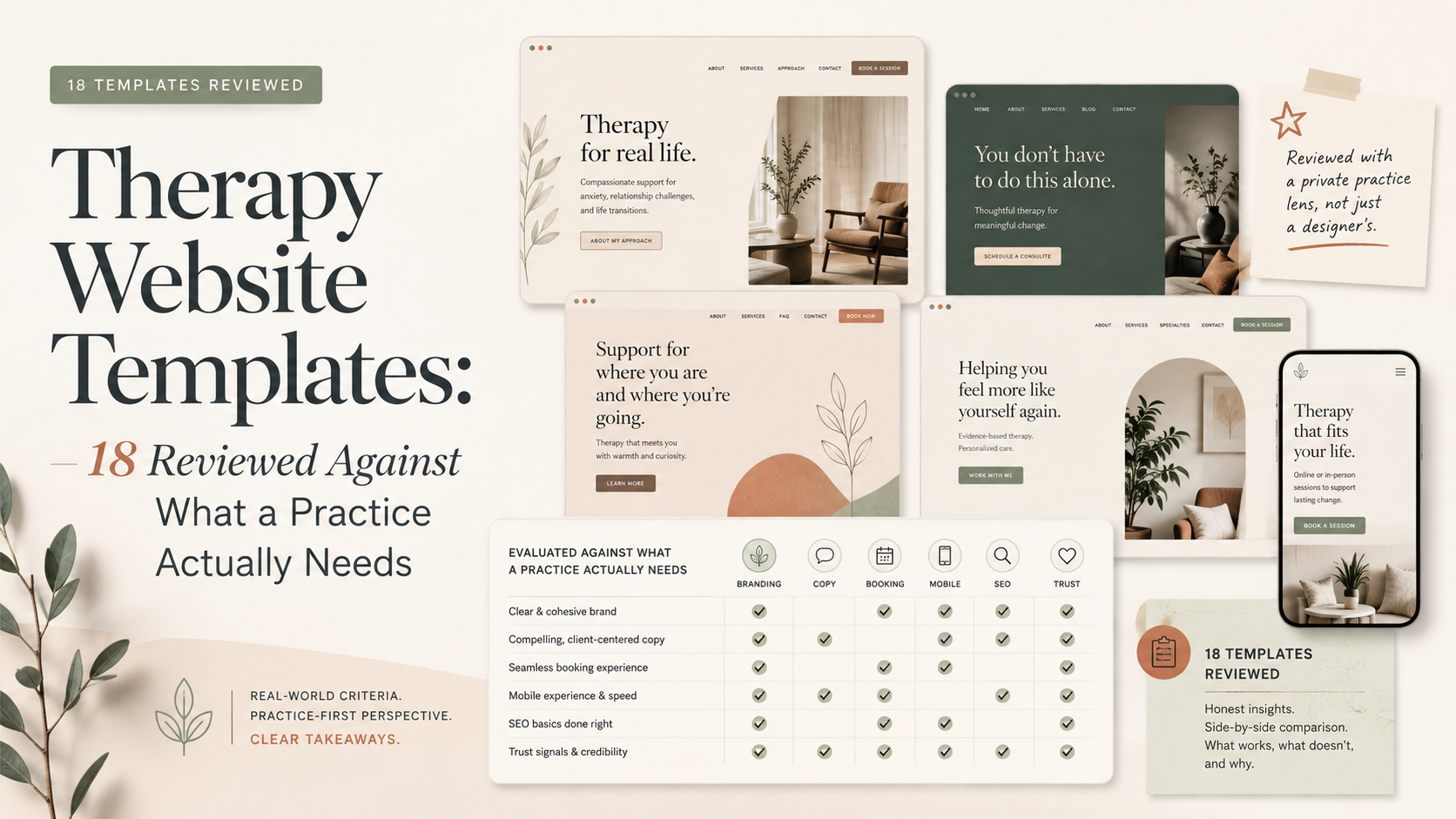
Therapy Website Templates: 18 Reviewed Against What a Practice Actually Needs
Every page ranking for this search is selling you a template. We sell none of them, so here are 18 scored on the six things that break a therapy site: intake embeds, booking, fees, contrast, mobile load and lock-in.

Branding for Therapists: A Step-by-Step Framework to Build Yours
If you're reading this, you've probably already made peace with the idea that your practice needs a brand. What you actually want is the next part: a sequence you can follow this week, not another article explaining why sage green and a lotus icon won't cut it.
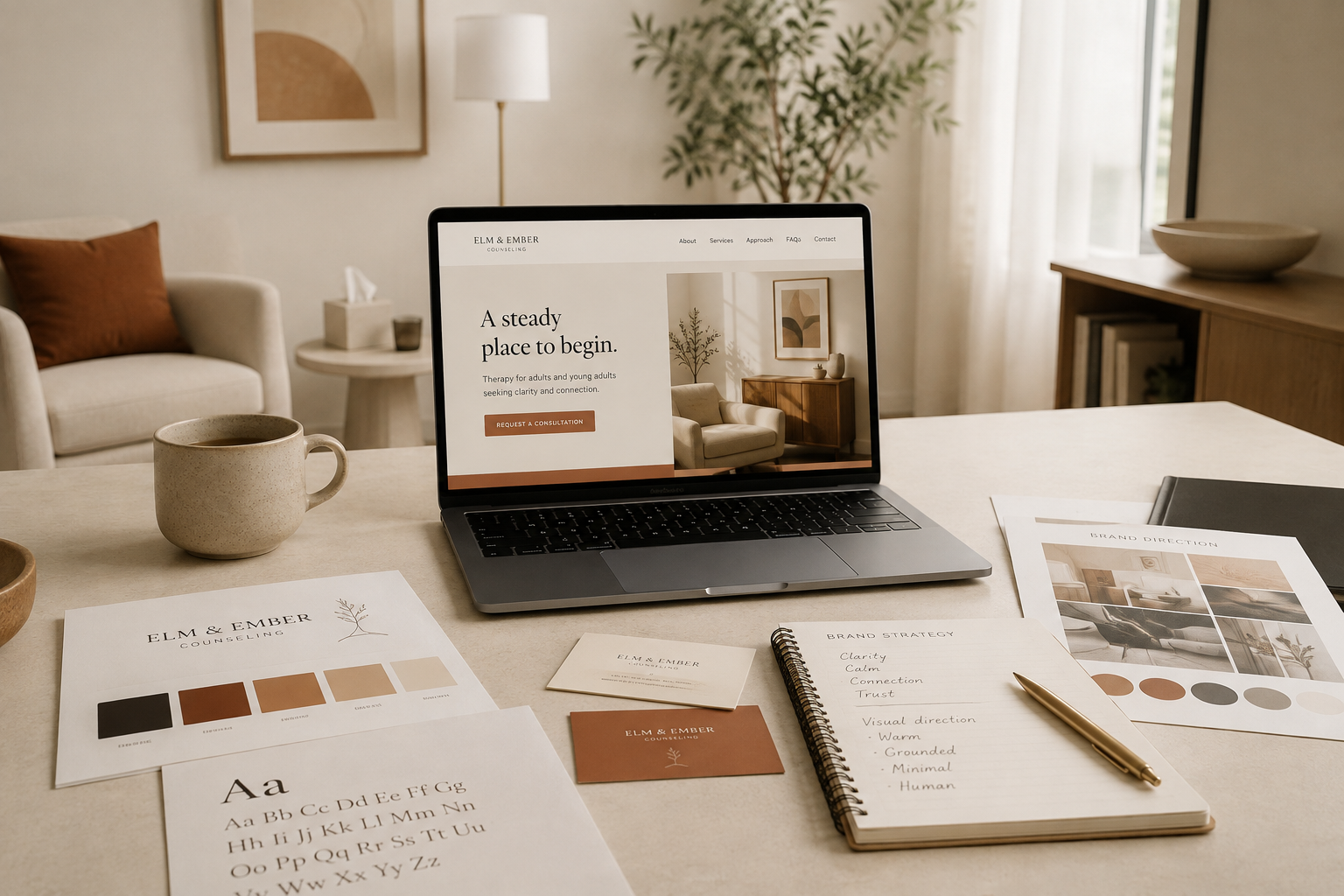
Therapist Branding: How to Build a Practice Brand People Actually Trust
Open ten therapist websites in a row and something uncomfortable happens. Sage green. A lotus. A dandelion letting go of its seeds. A headline promising a safe space to heal. Every practice is warm, every practice is welcoming, and after the fourth tab they blur into one.