BRANDING · AUGUST 16, 2026
Therapist Branding: How to Build a Practice Brand People Actually Trust
Open ten therapist websites in a row and something uncomfortable happens. Sage green. A lotus. A dandelion letting go of its seeds. A headline promising a safe space to heal. Every practice is warm, every practice is welcoming, and after the fourth tab they blur into one.
Open ten therapist websites in a row and something uncomfortable happens. Sage green. A lotus. A dandelion letting go of its seeds. A headline promising a safe space to heal. Every practice is warm, every practice is welcoming, and after the fourth tab they blur into one.
That sameness is the real problem therapist branding has to solve. Not prettiness. Not a logo. The person scrolling those tabs is anxious, probably paying out of pocket, and trying to guess which stranger they can tell the truth to. Your brand is the only evidence they have before the consultation call.
Why does branding matter more in mental health than almost anywhere else?
Most purchases let people test the product. Therapy doesn’t. A potential client commits to sitting in a room and being vulnerable with someone they’ve never met, at $150 to $250 a session, based on a website and a directory photo.
So they read signals instead. Does this person work with people like me? Do they sound like a human being or a brochure? Would I feel safe in that first session?
Effective branding is just the deliberate management of those signals — the ones potential clients pick up in the ten seconds before they decide whether to keep reading. It’s the difference between “a therapist” and “the therapist who clearly gets what I’m dealing with.” There’s a business argument too. Anyone running a private practice knows the arithmetic: therapy practices that rely on insurance panels and a generic Psychology Today listing compete almost entirely on availability. A strong brand is what lets you fill a private-pay caseload, raise your rate without apology, and stop taking every referral that lands in your inbox.
Start with the person, not the palette
Nearly every guide tells you to find your niche. Fewer explain what to do with it.
A niche is not “anxiety.” Anxiety is half your profession. A usable definition of your ideal client names a situation: first-generation professionals whose success came with guilt. Couples deciding whether to stay after an affair. Parents of a newly diagnosed autistic child. New physicians in their intern year.
Write down the type of client you want more of, then answer four questions in their words, not clinical ones:
- What are they Googling at 11 p.m.?
- What have they already tried that didn’t work?
- What are they afraid you’ll think about them?
- What would make them close the tab?
Those answers become your homepage copy, your directory profile, and your social media captions. They are also the only reliable way to attract ideal clients rather than simply more clients, which is a distinction most private practice owners learn the expensive way. This is the least glamorous part of building a brand identity and the part that does the most work. Skip it and you’ll spend money on a logo that decorates a message no one recognizes.
The three decisions that carry your brand identity
Before any design happens, lock three things.
Your practice name. Your own name is a legitimate choice and travels well if you ever leave a group. A place name grounds you locally, which matters for searches like “therapist in Park Slope.” Abstract nature names — Willow, Anchor, Harbor, Roots — are so common now that they cost you distinctiveness rather than adding any. Whatever you pick, check the URL, your state’s business registry, and whether it’s pronounceable over the phone.
Your promise. One sentence a client could repeat to a friend. “I help adult children of alcoholics stop managing everyone else’s feelings” beats “compassionate, client-centered care for individuals and families” every time.
Your voice. Pick three adjectives and hold yourself to them. Steady, direct, warm. Or unhurried, curious, plain-spoken. Voice is what makes a therapist website feel like one specific person rather than a category.
Visual identity without the clichés
Now the design. Your visual identity is a palette, two typefaces, a mark, and a set of rules about how they’re used — nothing more exotic than that.
Color first, because it carries the most meaning fastest. The reflex in mental health is sage and dusty blue, which read as calm mostly because everyone else is using them and clients have learned the code. Warmer palettes — clay, ochre, muted terracotta — signal approachability and stand out in a directory grid. Deep plum and slate read as serious and contained, which suits trauma work far better than pastel gentleness does. What clients feel when a page loads is set in about a second, so pick a direction on purpose rather than by default.
Typography does the rest. A serif with real personality for headlines and a clean humanist sans for body text will separate you from the Montserrat-on-white template look immediately. Set body text at 18px minimum and give it generous line spacing. People arrive at therapy websites tired.
The logo matters least, which surprises people who think a logo is branding. A wordmark set in your display typeface, with one small distinguishing detail, is plenty. Nobody has ever chosen a therapist because of an icon.
The layer nobody else writes about: your ethics code
This is where most branding advice written for general small businesses becomes dangerous for therapists.
The ACA Code of Ethics is explicit: counselors “do not solicit testimonials from current clients and/or former clients, and any other persons who may be vulnerable to undue influence” (C.3.b), and must present credentials in a way that is “not false, misleading, deceptive, or fraudulent” (C.3.a). The APA Ethics Code sets a comparable bar for psychologists at Standard 5.05. State boards layer their own advertising rules on top, and they vary.
The practical translation for your marketing:
- No client testimonials. No review requests, no “here’s what my clients say,” no reposting a thank-you text. The social proof playbook every marketing blog recommends is off-limits to you.
- No outcome promises. “Heal your anxiety in 12 weeks” is a claim you can’t make. “Learn what your anxiety is protecting you from” is a description, and it’s stronger writing anyway.
- Credentials stated exactly. License type, license number where required, state of licensure, and no borrowed authority from unrelated doctorates.
- Psychoeducation is your substitute for proof. You demonstrate competence by explaining something well, not by collecting stars.
Build these rules into your brand from day one and you never have to unwind a campaign later. Therapy collectives and group practices need this written down explicitly, since every clinician posting under the practice name is representing it.
What a therapist website has to do
Your online presence doesn’t need many pages. It needs five things to work.
- Say who you help in the first screen. Specific enough that the wrong-fit visitor leaves and the right one exhales.
- Show your face. One good photo, eye contact, no stock imagery of hands holding sunsets.
- Explain the first session. What happens, how long, what it costs. Ambiguity about fees reads as a trap, especially to private-pay clients.
- Make one obvious next step. A single button. Not five.
- Load fast on a phone at night. That’s when people book.
On therapist branding photos: a session with a photographer who shoots for clinicians is one of the better spends once your positioning is settled, because those images give you a year of consistent social media content and a real face on every profile. Doing it before you know your palette and your message is how people end up with 40 photos they can’t use.
What it actually costs
Four paths, and the right one depends less on your budget than on how settled your positioning is.
Doing it yourself — Canva, a free template, an afternoon — costs somewhere between nothing and $100. That's the honest choice pre-licensure, or in the first six months when you're still testing which type of client you actually want. Spending more before you know that is spending on a guess.
An AI brand kit built from a guided brief runs roughly $79 to $249 as a one-time payment. It makes sense once you can name your ideal client but don't have weeks to spend on the visual identity — you get a coherent palette, typography and copy in an hour instead of a quarter.
A semi-custom designer, at $800 to $2,000, is worth it when you have an established caseload and specific requirements a template can't handle: a name that needs a real mark, or a look you can already describe precisely.
A full brand studio starts around $2,500 and climbs past $5,000. Reserve it for group practices and therapy collectives, where several clinicians share one identity and the decision has to hold for years.
There's no moral hierarchy here. A clear $79 identity beats a muddled $3,500 one, and a great designer earns every dollar when you hand them something specific to express.
There’s no moral hierarchy here. A clear $79 identity beats a muddled $3,500 one, and a great designer is worth every dollar when you have something specific for them to express.
Consistency is the whole game
A consistent brand is simply the same colors, the same voice, and the same promise everywhere a person meets you — website, directory profile, intake paperwork, appointment reminders, invoices, the room itself. The client experience should feel continuous from the first search to the tenth session. That continuity is what turns branding for therapists from decoration into trust. Review it once a year, ask whether it still describes the practice you actually have, and change it when it doesn’t.
FAQ
Do I need branding if I already have a full caseload?
Not urgently. But a full caseload built on referrals is fragile, and branding is what lets you replace low-fit clients with better ones when you eventually want to.
Can I use client reviews if the client offers voluntarily?
Check your board and your code — for counselors and psychologists, soliciting them is prohibited outright, and publishing an unsolicited one still risks confirming that someone is a client. Most ethics consultants advise against it.
What colors work best for a therapy practice?
The ones that match your actual work. Trauma-focused practices often do better with contained, quiet palettes than with soft pastels, which can read as minimizing.
How long does it take to build a brand?
The thinking takes a week of honest reflection. The execution can take an afternoon or three months, depending on the path you choose.
Your practice, branded. In under an hour.
A guided brief, three directions, and website copy ready to paste in.
Build my brand kitMore in Branding

Branding for Therapists: A Step-by-Step Framework to Build Yours
If you're reading this, you've probably already made peace with the idea that your practice needs a brand. What you actually want is the next part: a sequence you can follow this week, not another article explaining why sage green and a lotus icon won't cut it.
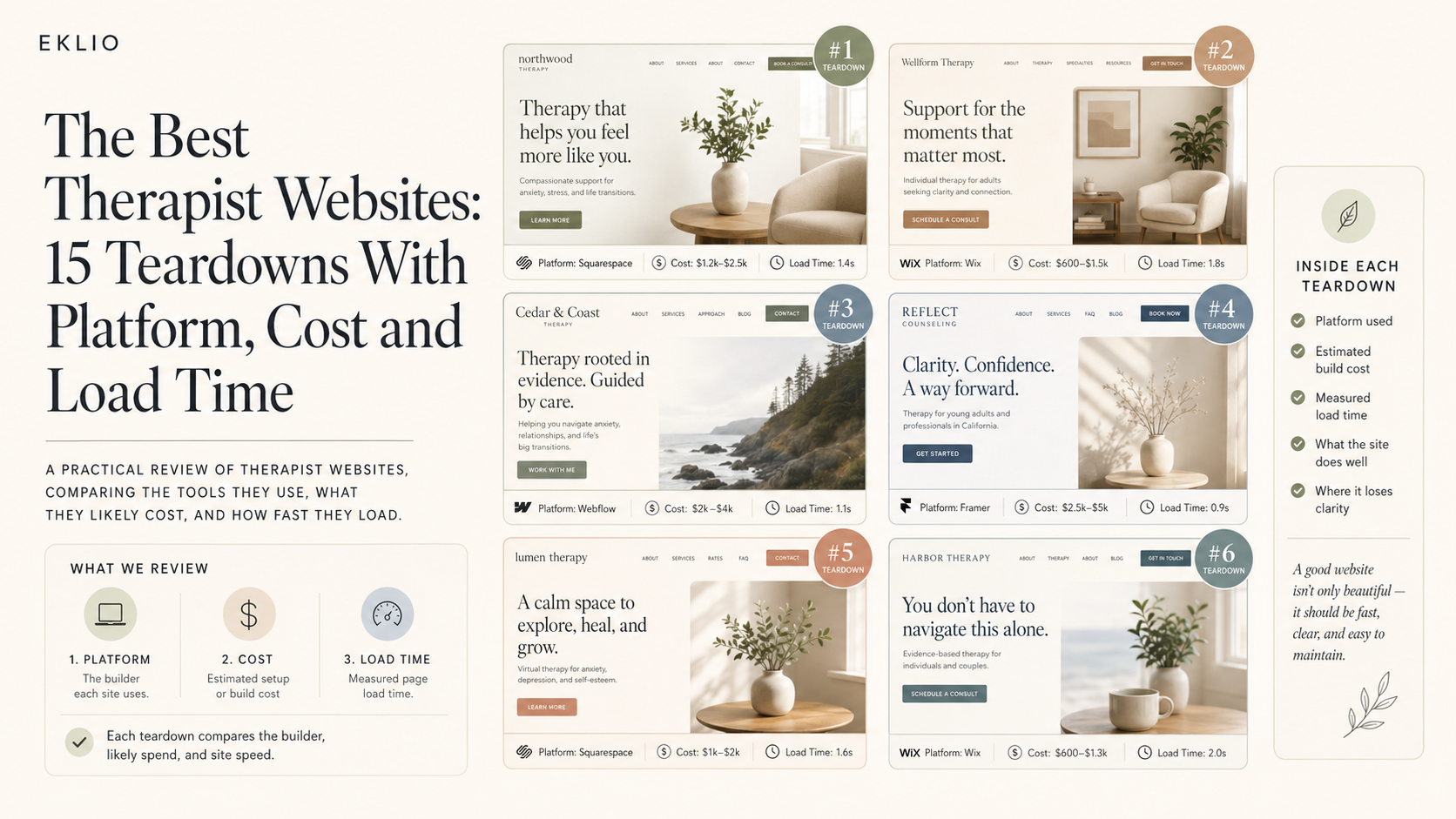
The Best Therapist Websites: 15 Teardowns With Platform, Cost and Load Time
Most "best of" lists for therapist sites are a gallery with no criteria. We opened the source on fifteen, ran each through Lighthouse on throttled mobile, priced the build, and ranked them.
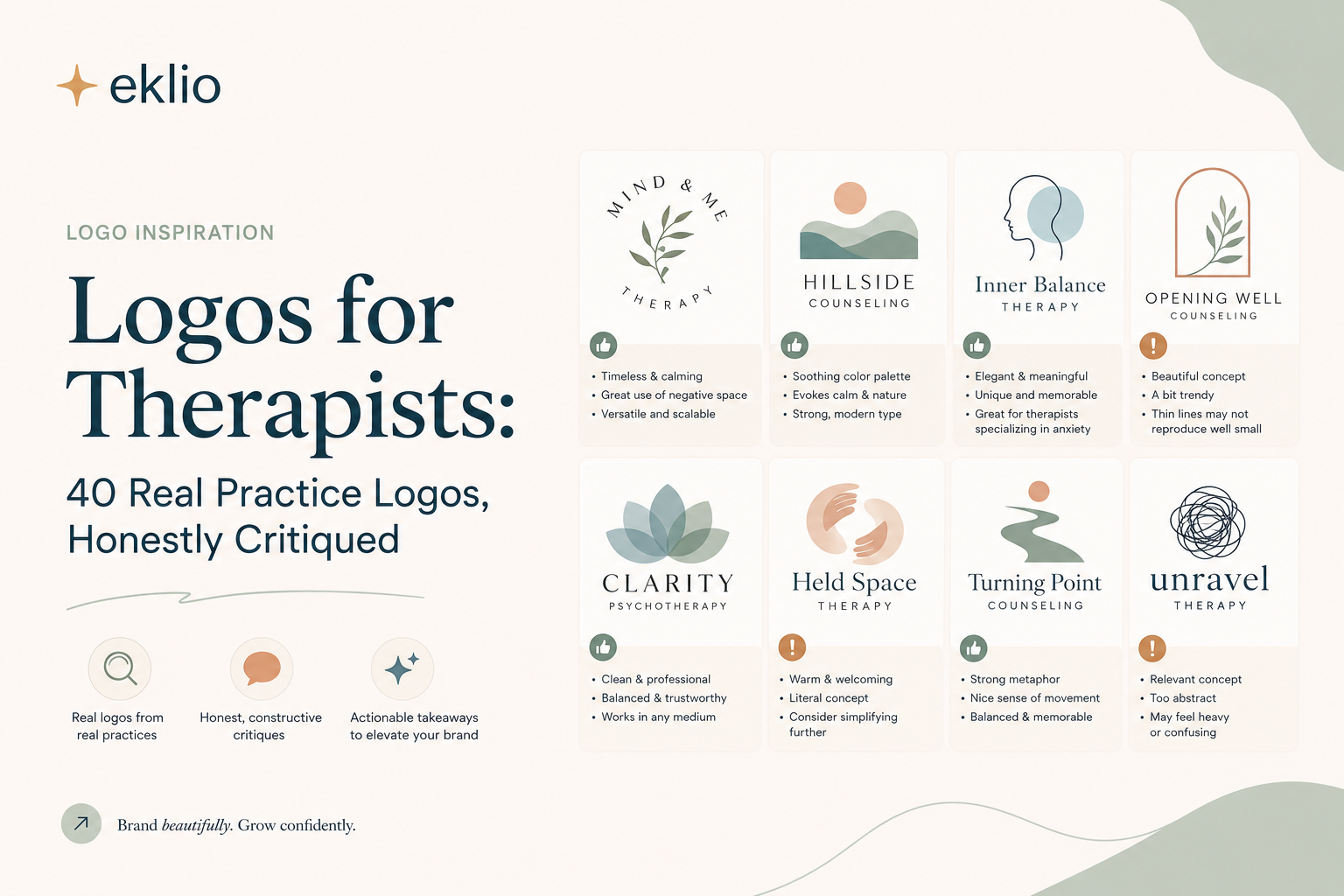
Logos for Therapists: 40 Real Practice Logos, Honestly Critiqued
We shrank forty real therapist logos to 32 pixels to see which ones survived. Eleven did. Here is what the other twenty-nine got wrong, and the six symbols we saw over and over.