
WEBSITES · SEPTEMBER 20, 2026
Therapy Website Templates: 18 Reviewed Against What a Practice Actually Needs
Every page ranking for this search is selling you a template. We sell none of them, so here are 18 scored on the six things that break a therapy site: intake embeds, booking, fees, contrast, mobile load and lock-in.
Search therapy website templates and every result on page one is selling you a template. That is not a conspiracy, it is just what a commercial query looks like. But it does mean nobody on that page is in a position to tell you which of these designs falls apart the moment you paste in a SimplePractice intake link, or which one you cannot take with you when you leave.
Eklio sells no templates. We make brand kits that customers install on whatever platform they already chose, which gives us no reason to talk you into a $340 Showit file or out of a free Wix theme.
For a solo or small practice, the best therapy website templates are the ones that accept an arbitrary iframe or code block, link cleanly to your EHR's booking page, hold a readable fee section, and let you leave. Design is the easiest of those five to fix later. Lock-in is the hardest.
The six criteria we scored
A therapy site does a narrow set of jobs. Most template reviews grade on how the homepage looks, which is the one thing you can change in an afternoon. We scored on six things you cannot.
Intake form embed. Can you drop in a raw iframe or <script> from SimplePractice, Jane, SessionsHealth, Jotform or a HIPAA-eligible form host, on any page, at any width, without the submit button falling off the bottom on a phone? A surprising number of templates only allow embeds inside a fixed-height container.
Booking and telehealth integration. Almost no template integrates natively with a clinical EHR — a link or an embed is the realistic ceiling. What varies is whether the design gives that button an obvious home above the fold.
Fee page pattern. Somewhere to state a rate, a sliding-scale note, an out-of-network explanation and a Good Faith Estimate line. Templates built for wellness coaches ship a three-tier pricing block that reads wrong for clinical work.
Accessibility contrast. Whether the shipped palette clears WCAG AA (4.5:1 for body text). Soft sage on cream is the house style of this niche and it fails more often than it passes.
Mobile load. Full-bleed hero video and four web fonts are common here, and both are slow on a phone on cell data — which is how most referrals arrive.
Lock-in. What you can take with you. This is the criterion nobody selling a template wants to discuss.
The 18 therapy website templates, scored
Scores are ours, on a 1-5 scale, checked in August 2026; prices move, so confirm before you buy. Where a row covers many small design shops, we scored the platform behaviour they all inherit, because individual files change monthly.
| Template / source | Typical price | Intake embed | Booking link | Contrast | Lock-in risk | Best for |
|---|---|---|---|---|---|---|
| Squarespace built-in (Fluid Engine) | $16-23/mo | 5 | 5 | 4 | Medium | Most solo practices |
| Squarespace files from design shops | $150-500 + plan | 5 | 5 | 3 | Medium | A look you can't build yourself |
| Wix built-in therapist templates | $0-27/mo | 4 | 4 | 3 | High | Fastest free start |
| Wix Studio templates | $29+/mo | 4 | 4 | 4 | High | Group practices on Wix |
| Showit therapist templates | $100-400 + $24/mo | 3 | 4 | 3 | High | Designers' favourite, not exportable |
| Webflow marketplace wellness | $79-149 once | 5 | 5 | 4 | Low | You have a developer |
| Framer marketplace wellness | $39-99 once | 5 | 5 | 4 | Medium | Speed and motion |
| WordPress + Kadence starter | $0-129/yr | 5 | 5 | 4 | Low | Owning your files |
| WordPress + Elementor kit | $59-99/yr | 5 | 5 | 3 | Medium | Heavy page editing |
| WordPress + Divi layout pack | $89/yr | 5 | 4 | 3 | High | Existing Divi users |
| Ghost themes | $9-19/mo | 4 | 4 | 4 | Low | Writing-led practices |
| Carrd one-pager | $19/yr | 3 | 4 | 4 | Low | A pre-launch holding page |
| Super + Notion | $12/mo | 3 | 3 | 4 | Low | Fast, plain, unpolished |
| Brighter Vision | ~$59-99/mo | 5 | 5 | 4 | Very high | Hands-off, done-for-you |
| TherapySites | ~$59/mo | 5 | 5 | 3 | Very high | Hands-off, older platform |
| SimplePractice website builder | Add-on to plan | 5 | 5 | 4 | Very high | Already all-in on SimplePractice |
| Jane practice pages | Included | 4 | 5 | 4 | Very high | Multi-clinician booking first |
| Psychology Today profile | ~$29+/mo | 2 | 4 | 4 | Total | A directory, not a website |
Two things stand out. The therapist-specific done-for-you platforms score best on the clinical criteria and worst on lock-in; that trade is the whole story of this market. And the generic builders beat the pretty niche templates on intake embeds, because they impose fewer container rules.
The highlighted row is Squarespace's own current templates, and it is a boring answer. They accept any embed, load acceptably, cost a predictable amount, and let you export your text if you leave. The longer argument about platforms rather than files is in best website builder for therapists.
Where lock-in actually bites
"Lock-in" sounds abstract until you are three years in with a full caseload and a site you cannot move. Here is what each level means concretely.
| Level | What you can export | What you lose | Realistic move cost |
|---|---|---|---|
| Low | Code, content, design | Nothing but your time | A weekend |
| Medium | Content and images | Layout, custom styling | 1-2 weeks or $500-1,500 |
| High | Content only, by hand | Design entirely | 2-4 weeks or $1,500-3,000 |
| Very high | Text you copy manually | Design, URLs, sometimes the domain | Full rebuild |
| Total | Nothing structural | It was never your site | Start over |
The one to check before you sign: who holds the domain registration. On several done-for-you platforms the vendor registers it during onboarding. That is usually transferable and usually fine, but "usually" is doing a lot of work in that sentence. Ask in writing, before you pay.
The testimonial block nobody mentions
Roughly half the templates we looked at ship with a testimonials section — quote cards, star ratings, a slider. For a photographer that is the highest-converting block on the page. For you it is a liability. ACA C.3.b prohibits soliciting testimonials from current clients and from former clients vulnerable to undue influence; APA 5.05 and NASW 4.07 say substantively the same thing.
You cannot fill that block ethically, and you cannot always delete it cleanly — on some Showit and Divi files it is welded into the layout grid, and removing it leaves a gap the page does not know how to close. Delete it first when you preview. If the page still holds together, that is a real point in its favour.
The same instinct applies to the placeholder copy. Templates in this niche arrive full of headlines like "Feel like yourself again in 12 weeks." Replace promise with description before you launch, not after.
The case for not buying one at all
If you are pre-license, pre-caseload, or testing a niche, a $300 template is a bad purchase. One page with your name, license, modalities, fee, location and a booking link will carry you to a full caseload. Carrd does that for $19 a year.
Buy one when you have something the layout has to organise — several services, a group practice with clinician bios, a blog you actually write. Our checklist of what pages a private practice website needs will tell you whether you are there yet.
And a template gives you a layout, not an identity. Every therapist who buys the same sage-and-serif file gets the same site with different names on it, which is exactly the problem in a market where twelve LCSWs in your zip code all look interchangeable to a referrer. That is the gap Eklio fills: a 7-minute brief produces your logo, palette, type and brand board, plus export-ready prompts for Squarespace, Wix, Framer and Webflow, from $79 one-time. Buy the layout wherever you like. Bring your own identity to it.
What to check in the demo before you pay
Open the live demo on your phone, not your laptop, and time the load. Then find a page where a wide embed sits inside normal body content, because that is where your intake form is going. If no such page exists, assume nobody tested for it. If you would rather build from scratch than audit someone else's file, how to make a therapist website covers the same decisions without a purchase.
Frequently asked questions
Can I put an intake form on any therapy website template?
Almost, but not quite. Any template that offers a raw HTML or code block will take a SimplePractice, Jane or Jotform embed. The failures are platforms that only allow embeds inside fixed-height containers, which crops tall forms on mobile. Test with your actual form, not a short demo form, before you commit.
Are therapist website templates HIPAA compliant?
A template is not compliant or non-compliant on its own — compliance sits with the form and the hosting arrangement behind it. A marketing site with no PHI on it is generally low risk. The moment you collect intake data, that collection needs to happen in a HIPAA-eligible service under a BAA, embedded into your page rather than built from your website builder's ordinary contact form.
How much should I pay for a counseling website template?
Between $0 and about $150 for the file, plus your platform's monthly plan. Above $300 you are paying a design shop for taste rather than function. That can be worth it, but check the six criteria first, because taste does not fix a broken embed.
What happens if I leave the platform later?
That depends entirely on the lock-in column. On WordPress or Webflow you take the files. On a done-for-you therapist platform you typically take your text, retype it somewhere else, and rebuild the design. Before you sign, ask two questions in writing: can I export my content, and is the domain registered in my name?
Your practice, branded. In under an hour.
A guided brief, three directions, and website copy ready to paste in.
Build my brand kitMore in Websites
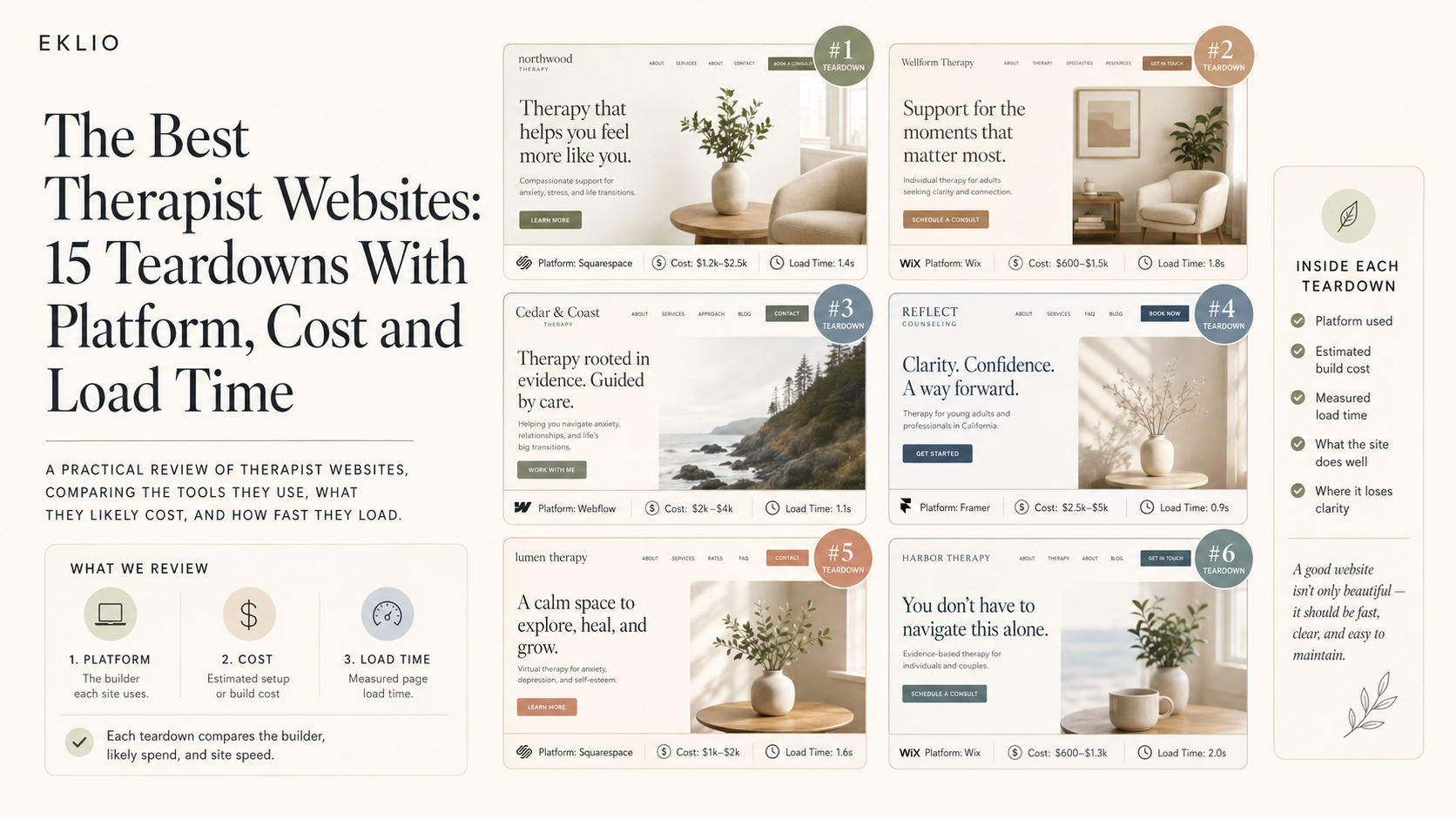
The Best Therapist Websites: 15 Teardowns With Platform, Cost and Load Time
Most "best of" lists for therapist sites are a gallery with no criteria. We opened the source on fifteen, ran each through Lighthouse on throttled mobile, priced the build, and ranked them.

Branding for Therapists: A Step-by-Step Framework to Build Yours
If you're reading this, you've probably already made peace with the idea that your practice needs a brand. What you actually want is the next part: a sequence you can follow this week, not another article explaining why sage green and a lotus icon won't cut it.

Therapist Branding: How to Build a Practice Brand People Actually Trust
Open ten therapist websites in a row and something uncomfortable happens. Sage green. A lotus. A dandelion letting go of its seeds. A headline promising a safe space to heal. Every practice is warm, every practice is welcoming, and after the fourth tab they blur into one.